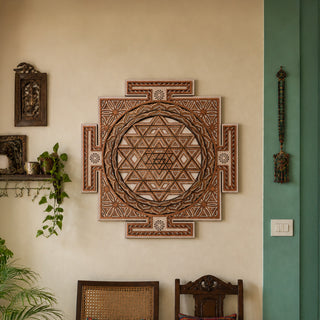
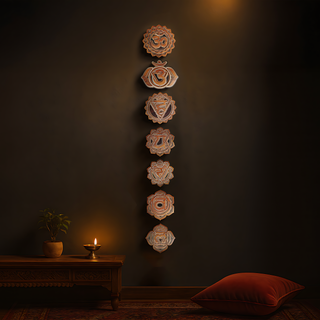
For most Indian homes, place a Shree Yantra on a clean east or north-east wall in the pooja room, meditation area, or another respectful space. Its traditional benefits are symbolic: the Sri Chakra supports daily focus on harmony, abundance, and disciplined attention; it is not a guarantee of material results.

We are Sutrayan Studio, and in our Kanpur workshop we translate this sacred geometry into layered wooden wall art. This guide separates traditional placement guidance from practical interior decisions, so you can choose a direction, height, and room that feel considered rather than superstitious or forced.
What is a Shree Yantra, and why is it kept at home?
A Shree Yantra, also called Sri Chakra, is a sacred geometric diagram formed by nine interlocking triangles around a central point, or bindu. The intersecting triangles are commonly understood as a union of complementary principles, while the enclosing lotus forms and outer square create a visual journey from the material world towards a centred inner point.
In a home, that geometry can serve three roles. It can be a devotional object in a pooja room, a visual anchor for meditation, or meaningful wall decor in a quiet living space. The intention matters. A Shree Yantra should not be treated as a quick fix for money, health, or relationships. Its practical value comes from the attention and regularity it invites: a dedicated place, a calmer routine, and a reminder of balance.
Our Shree Yantra Sacred Wall Art renders the Sri Chakra in seven precision-cut layers and is currently offered in 12, 17, and 22-inch square sizes. It is made from premium engineered pine (MDF), assembled and finished by hand, and designed to read clearly as both sacred geometry and a sculptural wall hanging.
What are the traditional benefits of Shree Yantra for the home?
Traditional practice associates the Shree Yantra with prosperity, harmony, clarity, and spiritual focus. The most responsible way to understand those benefits is as intentions supported by ritual and environment, not outcomes promised by an object. A well-placed yantra creates a visible centre for prayer, reflection, gratitude, or goal-setting.
- Focus: the bindu gives the eye a natural point on which to settle during quiet reflection.
- Order: repeated triangles and concentric boundaries express balance within complexity.
- Prosperity: many households connect Sri Chakra worship with abundance, while understanding prosperity as material and inner well-being.
- Continuity: a permanent place on the wall can make a daily practice easier to remember.
- Meaningful decor: sacred geometry can give a pooja room or meditation corner a clear focal point without adding visual clutter.
None of these associations replaces financial planning, medical care, or practical action. Think of the artwork as a cue for the values you want to practise. That distinction keeps the symbolism meaningful and prevents vastu advice from becoming a source of anxiety.
Which direction is best for Shree Yantra placement?
East and north-east are the most commonly recommended directions for a Shree Yantra in an Indian home. East connects naturally with morning light and a fresh daily beginning; north-east is often reserved for prayer and contemplation. North can work when the room layout makes the preferred walls impractical.
| Wall or zone | Traditional reading | Best suited to | Practical guidance |
|---|---|---|---|
| East wall | Beginning, light, clarity | Pooja room, meditation corner, calm living area | Use gentle daylight; avoid harsh direct sun on the finish |
| North-east zone | Contemplation and spiritual practice | Dedicated pooja or prayer space | Keep the wall clean and the area uncluttered |
| North wall | Growth and forward movement in popular vastu practice | Study, home office, reflective corner | Choose a position visible from the main seat |
| West wall | Secondary choice when the room requires it | Living room or meditation space | Prioritise respect, visibility, and a stable mounting point |
| South or south-west wall | Not the usual first choice for sacred placement | Use only when household tradition supports it | Ask your family priest or vastu adviser if direction is important to your practice |
Direction is only one part of placement. A respectful, clean wall in a lived-in pooja room is usually a better choice than a theoretically perfect direction beside a shoe rack, television, bathroom door, or damp surface. Our broader Vastu wall art guide helps match symbols and rooms without turning the home into a rigid diagram.
Where should Shree Yantra be placed in each room?
In a pooja room, position the centre of the yantra where it can be seen comfortably during prayer. It need not dominate the altar. Leave enough clear wall around the square outline so the geometry remains legible, and avoid crowding it behind garlands, shelves, or electrical wires. The pooja room wall decor guide covers scale and layering for compact niches as well as dedicated rooms.
In a meditation corner, hang the piece on the wall you naturally face while seated. The lower sightline of floor seating means conventional standing eye level may be too high. Sit in your normal position, look forward without lifting your chin, and use that line to establish the centre.
In a living room, choose a quiet secondary focal wall rather than placing sacred art in competition with the television. A console wall, reading corner, or transition near the pooja space often feels more intentional. In a study or home office, use the north or east wall if that agrees with your practice, but make sure the piece does not sit behind a frequently opened door.
At what height should a Shree Yantra wall hanging be installed?
For a standing or living-room view, start with the artwork’s centre near average eye level, roughly 145 to 155 cm from the floor, then adjust for furniture and the people who use the room. Above a console or altar, leave a deliberate gap rather than letting the piece appear to rest on the furniture.
For floor-seated prayer or meditation, install it lower. Mock the size with paper, sit at your usual distance, and check whether the bindu meets a relaxed gaze. This simple test is more useful than following a universal measurement because Indian pooja spaces range from compact wall niches to full rooms.
Also check the mounting surface. Keep premium engineered pine (MDF) away from damp walls and direct contact with water. Use the supplied hanging arrangement and suitable wall fasteners for the wall type; when in doubt, ask an installer to identify masonry, gypsum board, or panelling before drilling.
How do you choose the right Shree Yantra size?
Choose size by viewing distance and available wall width, not by the desire to make the symbol as large as possible. A 12-inch piece suits a compact pooja niche or a small meditation corner. A 17-inch piece has more presence over a console or in a medium pooja room. A 22-inch piece needs a clear feature wall and more viewing distance.
Mark the outer square on the wall with low-tack paper tape. Step back to the doorway and then sit where the piece will usually be viewed. If the outline disappears among shelves and frames, move up a size; if it presses against cabinet edges, move down. The right scale gives the geometry breathing room.
To compare the symbol with other contemplative designs before choosing, browse the Sacred Wall Icons collection.
How should a Shree Yantra be oriented and cared for?
Mount a square Shree Yantra level, with the geometry upright as shown on the product page. Do not rotate it simply to make it fit a diamond-shaped gap unless the design was created for that orientation. Before installation, inspect the front and hanging hardware, and handle the piece from its sturdier outer edges.
Dust the layered surface with a soft, dry microfibre cloth or a soft brush. Do not use a wet cloth, spray cleaner, or oil on the finish. Layered work has recesses where moisture can settle, so light, regular dusting is better than an occasional deep clean. Our wooden wall art care guide for Indian humidity explains seasonal placement and cleaning in more detail.
If your family follows a specific consecration or पूजा method, follow that lineage or consult the priest who guides your household. A studio can explain the material and installation; ritual practice belongs to the tradition you trust.
What should you avoid when placing Shree Yantra wall art?
Avoid damp or flaking walls, direct splash zones, and locations where the piece can be knocked by a door. Many households also avoid sacred imagery in bathrooms, directly beside footwear, or in places treated casually. Those are questions of respect as much as direction.
Do not choose a placement that makes everyday life awkward. If an east wall is occupied by essential storage, use a suitable north-east or north location rather than creating clutter. Do not hide damage behind the art, and never hang a heavy piece from an untested adhesive hook. For a wider cultural overview, read our Vastu-compliant wall art placement article.
Written by Sutrayan Studio. We design, cut, assemble, and hand-finish layered wall art in our workshop in Kanpur.
What do people ask about Shree Yantra for the home?
Shree Yantra ghar mein kahan lagayen?
Shree Yantra ko saaf east ya north-east wall par, pooja room ya meditation corner mein lagana sabse common guidance hai. Placement respectful aur uncluttered rakhein. Agar ghar ki layout mein yeh direction practical na ho, north wall consider karein aur apne parivaar ki parampara ko priority dein.
Can Shree Yantra be placed in the living room?
Yes, especially on a calm east, north-east, or north wall away from the television and heavy visual clutter. Choose a location that your household treats respectfully and where the geometry can be seen clearly.
Should Shree Yantra face east or be placed on the east wall?
The phrases are often mixed up. “On the east wall” means the artwork faces west; “facing east” means it hangs on the west wall. Most placement advice names the wall or zone, so clarify the convention with whoever is guiding your ritual practice.
Can a wooden Shree Yantra be used for daily pooja?
It can form the visual focus of a pooja space if that suits your tradition. Keep it clean and dry, and remember that a wall artwork does not replace any specific ritual object prescribed by your family practice.
Which sources support this guide?
These references support the historical, material, conservation, or regulatory context used above. Spiritual and placement guidance is identified as tradition or interpretation, and decorative objects are not presented as medical, financial, or guaranteed remedies.
- On the construction of the Sri Yantra, C. R. Mathématique (2021)
- Sri Yantra construction article and bibliography, Numdam
- IGNCA publications on Vaastu and Indian architectural texts
Editorial review completed 30 August 2026. Product prices and availability can change; check the linked product page before ordering.