Where does the mandala form come from?
The mandala form comes from Hindu and Buddhist tantric traditions, where it served as a structured aid for meditation and visualisation. It was not merely decoration: the practitioner moved from an outer boundary toward a central point, using geometry to organise attention.

Modern wall art borrows this visual grammar in both sacred and decorative forms. A floral mandala can honour radial balance without claiming to reproduce a ritual diagram. The Vastu wall art placement guide explains why sacred-geometry pieces need more careful directional context.
What do the layers of a mandala represent?
Read a mandala from the outside inward. The outer boundary creates separation, the gates establish orientation, the lotus or patterned ring marks transition, the inner circle concentrates attention, and the bindu resolves the composition in one point. Individual designs vary, but this sequence is a useful interpretive framework.
| Layer | Common visual role | What to notice |
|---|---|---|
| Outer boundary | Defines and protects the field | Fire, walls, petals, or a geometric border |
| Cardinal gates | Orients the composition | Four openings on a cross-axis |
| Lotus or patterned ring | Marks a transition inward | Petal count, repetition, and rhythm |
| Inner field | Concentrates the main symbol | Deity, syllable, triangles, or colour |
| Bindu or centre | Provides a visual point of unity | The smallest and most concentrated point |
The outer ring
Classical iconography often describes the outer boundary as a wall of fire or protective enclosure. In contemporary decorative designs it may appear as petals, leaves, or a geometric border, but it still tells the eye where the mandala's visual world begins.
The cardinal gates
Four gates commonly mark east, south, west, and north. They create a cross-axis within the circular form and suggest that the viewer can enter the composition from an ordered direction rather than approaching a random pattern.
The lotus ring
Lotus petals represent purity and transition in many Indian visual traditions. A lotus ring softens the boundary between the outer protective structure and the inner focus, which is why it often reads as the most inviting layer in a wall piece.
The inner circle
The inner circle concentrates the deity, colour, seed syllable, or primary motif. In a Shree Yantra, the interlocked triangles intensify toward the centre; in a chakra composition, the central colour or symbol holds the eye.
The bindu
The bindu is a single central point representing unity or concentrated awareness. It gives the viewer a visual destination and keeps the many surrounding lines from feeling directionless.
How is a sacred mandala different from a decorative mandala?
Sacred-geometry mandalas follow a more specific symbolic system, while decorative mandalas use concentric balance, radial symmetry, and familiar motifs for visual or contemplative appeal. Both can be meaningful; the important distinction is to describe them honestly.
- Sacred geometry: Shree Yantra and 7 Chakras carry explicit tantric or yogic references.
- Decorative geometry: Bloom Whirl Flower Art and Koi Fish Mandala use radial form with floral or regional motifs.
Do not use a sacred name as a generic styling adjective. If the recipient wants a devotional piece, explain the symbol and placement; if the goal is calm decor, choose a design whose meaning is easy to welcome.
Why does multi-layered wood suit mandala art?
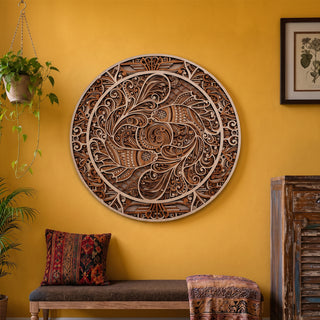
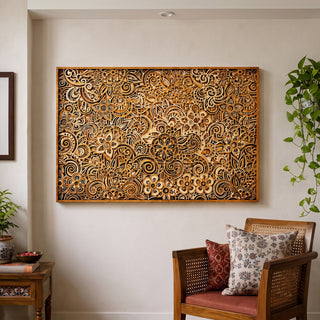
A flat print can reproduce the geometry, but layered wood gives the composition physical depth. Sutrayan mandalas typically use 5 to 9 layers of 3 to 6 mm engineered pine, so the outer ring, petals, and bindu sit at different heights and cast shadows into one another.
That construction makes the artwork legible from across a room and rewarding up close. Look for aligned layers, clean laser-cut edges, a sealed finish, and a mounting system that keeps the piece stable without crushing its projecting details. Compare the material experience with the 3D wood versus canvas guide.
Where should you place a mandala at home?
Decorative mandalas work on living-room focal walls, entryways, bedrooms, and meditation corners when the scale and lighting are calm. Sacred mandalas belong where the household can treat their symbolism respectfully; the wall should be dry, visible, and free from accidental contact.
- Above a console: centre the art to the furniture and leave breathing room around the circle.
- In a living room: use one strong focal piece rather than a busy cluster.
- In a meditation corner: mount the centre at a comfortable seated sight line.
- In a pooja room: confirm direction and symbol with the Vastu placement guidance.
Avoid bathrooms, damp kitchen walls, direct monsoon spray, and strong afternoon sun. For a practical maintenance routine, read the wooden wall art humidity care guide.
How can you read a mandala from outside to inside?
- Start at the border and notice the boundary, texture, and repeated rhythm.
- Find the four axes or gates and use them to orient the composition.
- Follow the petals and concentric lines toward the most detailed inner ring.
- Rest your attention on the bindu or central motif without inventing a meaning the design does not claim.
This reading method works for a traditional diagram and a contemporary wooden wall piece. The goal is attentive looking: the eye follows structure, while the material layers make the visual journey tactile.
What do readers ask about mandala meaning?
What does a mandala represent in Hindu and Buddhist traditions?
A mandala represents the cosmos as an ordered geometric field. Its concentric movement from boundary to centre can support meditation, visualisation, or contemplative looking, although the exact symbolism changes across traditions and individual designs.
Is a mandala religious or decorative?
It can be either. Shree Yantra and chakra mandalas have explicit spiritual references; floral, mehndi-inspired, and modern radial designs may use the same structure primarily for decorative or contemplative effect. Describe the design according to its actual source and intent.
Where should I hang a mandala at home?
Use a dry living-room focal wall, entryway, bedroom, or meditation corner. For sacred geometry, check directional guidance and keep the symbol visible and respectfully placed. Do not mount it where bathroom steam, kitchen oil, or direct rain can reach it.
How does a wooden mandala differ from a printed mandala?
Wood introduces relief, edge detail, and real shadow play through stacked layers. A print offers a flatter, lighter, and usually lower-cost presentation. The better choice depends on the room, budget, installation, and whether physical material is part of the desired experience.
What should you read next about mandala and wall art?
Learn where sacred symbols belong in an Indian home, compare layered wood with canvas prints, or see how light and scale shape a statement wall.
Explore handcrafted mandala and wooden wall art in the Sutrayan shop after deciding whether you want sacred or decorative geometry.
Explore the Sutrayan mandala collection.
Which sources support this guide?
These references support the historical, material, conservation, or regulatory context used above. Spiritual and placement guidance is identified as tradition or interpretation, and decorative objects are not presented as medical, financial, or guaranteed remedies.
- The Art of South and Southeast Asia, Metropolitan Museum of Art
- Taima Mandala, Metropolitan Museum of Art
- Theory and Practice of Temple Architecture in Medieval India, IGNCA
Editorial review completed 30 August 2026. Product prices and availability can change; check the linked product page before ordering.