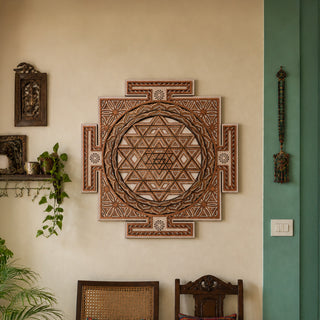
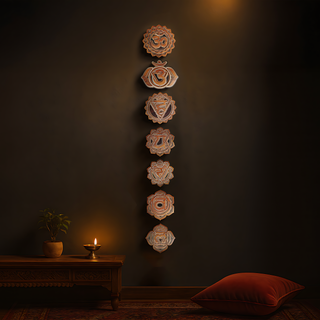
When an Indian household looks for a Shree Yantra, the symbol is usually settled. The harder choice is the form: a flat plate, a raised Meru, a crystal, a metal engraving, or a wooden wall relief.

The best Shree Yantra for a home is the form your household will keep clean, visible, and treated with respect. A flat or metal-engraved yantra suits a compact altar. A Meru form suits a dedicated pooja surface with space around it. A wooden layered relief suits a wall in a pooja room, meditation corner, or quiet living space.
What is a Meru Shree Yantra?
A Meru Shree Yantra is the same Sri Chakra raised into a pyramid. Tradition holds that the flat diagram, when projected upward, takes the shape of Mount Meru, the cosmic mountain in Hindu cosmology. Practitioners often call this raised form Meru, Meru-prastara, Sri Meru, or Maha Meru.
The diagram itself does not change. Nine triangles interlock around a central bindu. Four point upward and are commonly read as Shiva. Five point downward and are commonly read as Shakti. Their crossings make a field of smaller triangles, framed by lotus rings and an outer square. In the Sri Vidya tradition this geometry is the subtle form of Tripura Sundari. A Meru simply stacks that plan so the bindu sits at the peak and the outer square becomes the base.
You will usually meet a Meru as a standing object on an altar, not as a picture. Metal is common. Crystal and mixed materials appear too. Some pieces are a single cast or carved mass. Others are built as stepped levels. Either way, the Meru asks for floor or shelf space, a stable surface, and enough height that the peak is not crowded by a shelf above it.
A Meru is a good fit when your household already treats the Sri Chakra as a puja object, and when the mandir or pooja cabinet can hold a three-dimensional form without knocking it. It is a weaker fit on a thin wall ledge, behind a glass that fogs, or in a room where children and guests brush past the altar.
Practitioners believe the raised form helps the eye climb from the outer square toward the bindu. That is a way of looking, not a promised result. A carefully drawn flat yantra can hold the same attention if you sit with it.
What is a 3D Shree Yantra?
"3D Shree Yantra" is a shopper's phrase, not a single ritual type. It covers more than one object.
The traditional three-dimensional reading is the Meru described above: a pyramid whose plan is the Sri Chakra. When that plan is raised into three dimensions, the form is called Maha Meru or Sri Meru. If a listing says 3D and shows a stepped mountain on a square base, that is the Meru family.
A wooden layered relief is also three-dimensional, but in a different sense. The triangles are cut and stacked so light and shadow give the diagram depth on a wall. It is not a free-standing pyramid. It does not occupy an altar the way a Meru does. It is a wall object: closer to a sculptural hanging than to a temple meru.
Crystal pieces sit in both groups. Some sphatik yantras are small carved pyramids. Others are flatter carvings you can rest on a cloth. Sphatik, in ordinary Indian usage, is clear quartz. A quartz Shree Yantra is a material choice, not a separate geometry.
So when you search for a 3D Shree Yantra, decide first whether you want a standing Meru or a wall relief. Both have depth. They live in different parts of the house.
Which Shree Yantra is best for the home?
There is no single best type for every Indian home. Match the form to the room, the way your family prays, and the surface you actually have. If a family priest or a Sri Vidya teacher has already named a form, follow that guidance. The notes below are for households choosing without that instruction.
Flat, or Bhuprastha. Practitioners often call the level diagram Bhuprastha or Bhu-prastara, the earth-like form. It may be drawn, printed, painted, or engraved. It needs little depth, so it suits a compact pooja shelf, a wall niche, or a cupboard mandir. Keep the bindu readable. A faded print behind glass is harder to sit with than a smaller, clearer plate.
Metal-engraved. A copper, brass, or silver plate is still a flat yantra, made to last on an altar. Tradition treats engraved metal as a usual way to keep the diagram permanently, alongside drawings made for a specific rite. Metal suits daily wiping, travel between a hometown and a city flat, and families who want the object on the altar rather than on the wall.
Meru, or pyramid. Choose this when you have a dedicated pooja surface and want the Sri Chakra as a standing presence. Give it a clear base, a dry spot, and enough headroom. A Meru crowded by bottles, lamps, and photo frames loses the outline that makes it worth having.
Sphatik, or quartz crystal. A sphatik Shree Yantra is carved from clear quartz. It is usually small and meant for a table, peetham, or quiet shelf. Practitioners often like the way light passes through the stone. That is a visual quality. It does not make crystal more effective than metal or wood, and it is not a medical object. Buy crystal for clarity of the carving and for a size you can keep stable, not for claims about energy.
Wooden layered relief. This is the form we make at Sutrayan: the Sri Chakra translated into a multi-layered wooden hanging. It belongs on a wall, at a height you can see while standing or sitting for prayer. It suits a pooja room wall, a meditation corner, or a calm stretch of living-room wall that the household will treat with respect. It is not a substitute for a Meru if your practice specifically asks for a pyramid on the altar.
| Type | Form | Material | Typically suited for |
|---|---|---|---|
| Flat / Bhuprastha | Level diagram | Paper, cloth, painted surface, or metal plate | Compact altar, niche, or cupboard mandir |
| Meru | Raised pyramid | Metal, crystal, or mixed | Dedicated pooja surface with clear space |
| Sphatik | Carved standing or low piece | Clear quartz | Small table, peetham, or quiet shelf |
| Metal-engraved | Level engraved plate | Copper, brass, or silver | Daily altar use and a lasting flat form |
| Wooden layered relief | Wall relief | Layered wood, often pine MDF | Pooja, meditation, or quiet living-room wall |
A living room can hold a Shree Yantra if the wall is calm and the household treats the image as sacred, not as background beside a television. A bedroom can hold one only if the room is used respectfully. A bathroom wall is the wrong place for any of these forms.
If two types appeal equally, choose the one you can place well. A modest flat plate on a clean east shelf is a better household decision than a large Meru you have to hide in a cupboard.
What determines Shree Yantra price?
Across the market, price follows material, size, and the labour in the geometry. It does not follow a promised result.
Material sets the floor. A printed sheet costs less than a thick copper plate. Brass and silver sit higher still. Gold plating is a surface, not a different yantra. Sphatik prices move with the size of the stone and how clear the quartz is. Wood prices move with the substrate, the finish, and how the layers are cut and joined. Engineered pine (MDF) is not solid timber. A seller who names the substrate is easier to trust than one who says only "wood".
Size is the next lever. A palm-sized plate and a large wall relief are different objects to make, pack, and hang. Bigger is not more correct. Choose by viewing distance and by the wall or shelf you have.
Craftsmanship is the part you can see. Look at whether the nine triangles meet cleanly, whether the bindu sits in the centre, and whether the lotus rings and outer square stay even. A Meru whose steps wander, or a plate whose lines smear, is a poorer object even if the metal is advertised as fine. Laser-cut work can be precise. Hand finishing still decides whether the surface feels considered.
Consecration, when it is offered, is a ritual service attached to the object. It belongs to the priest or lineage who performs it. It is not a factory grade, and it is not a reason to ignore a badly drawn diagram.
Do not read a higher price as proof that prosperity or harmony will follow. Tradition holds that the Sri Chakra is a support for attention and devotion. Money outcomes remain a matter of work, circumstance, and belief, not of the invoice.
How should you place a Shree Yantra at home?
Placement is a separate question from type, and we have already written it out. Use the Shree Yantra benefits and placement guide for direction, room, height, and care. That article is the place for east and north-east walls, viewing height, and what to avoid.
In this choice of form, only a few placement facts matter. A Meru and a sphatik piece need a stable, dry surface. A flat plate needs a level stand or a niche where the bindu faces you when you sit. A wooden layered relief needs a dry indoor wall and fasteners suited to the wall type. For matching sacred geometry to a room without turning vastu into anxiety, see the vastu wall art guide.
If your family already follows a priest, let that source settle facing, consecration, and whether a wall hanging is acceptable beside, or instead of, an altar yantra.
If you want the Sri Chakra as a quiet wall presence rather than an altar object, Sutrayan's Shree Yantra Sacred Wall Art is our wooden layered reading of the same geometry. We laser-cut pine MDF in Kanpur, assemble the relief by hand, and finish it so the bindu and triangles stay readable in ordinary room light. It is a home object. It does not replace a Meru or a metal plate if that is the form your household practice asks for.
Which sources support this guide?
These references support the historical, material, conservation, or regulatory context used above. Spiritual and placement guidance is identified as tradition or interpretation, and decorative objects are not presented as medical, financial, or guaranteed remedies.
- On the construction of the Sri Yantra, C. R. Mathématique (2021)
- Sri Yantra construction article and bibliography, Numdam
- IGNCA publications on Vaastu and Indian architectural texts
Editorial review completed 30 August 2026. Product prices and availability can change; check the linked product page before ordering.