MDF is a good material for detailed wall decor when it is properly cut, sealed, kept indoors, and protected from water. Solid wood offers natural grain and repairability but moves with humidity; canvas is lighter and simpler. The best choice depends on detail, depth, wall conditions, budget, and the finish you want.

At Sutrayan Studio, we use the honest phrase premium engineered pine (MDF). It is not solid timber, and it should not be marketed as if it were. We choose it for clean laser-cut detail and consistent layered assembly, then cut, assemble, and hand-finish each piece in our Kanpur workshop.
What is MDF wall art?
MDF stands for medium-density fibreboard, an engineered panel made from refined wood fibres bonded under heat and pressure. Its surface is uniform, without knots or unpredictable grain changes. That consistency makes MDF suitable for routed profiles, fine laser-cut forms, painted finishes, and repeated layers that need to align closely.
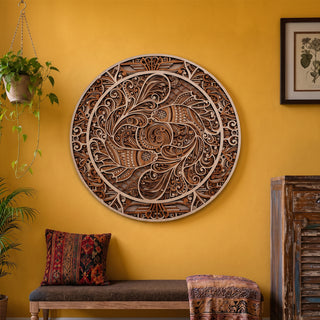
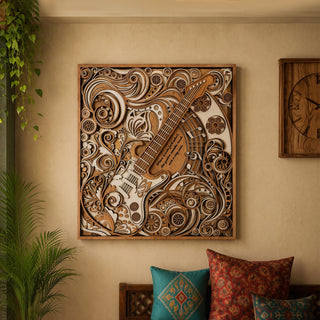
MDF wall art can be flat, engraved, cut through, or built into a relief. In layered work, separate profiles are cut and assembled so the finished object projects from the wall and casts real shadows. This is structurally different from a printed wood texture or a flat decal. Sutrayan pieces use premium engineered pine (MDF) in compositions of up to 9 layers, depending on the design.
The material still has limits. Unsealed edges can absorb moisture, damaged corners do not behave like carved hardwood, and prolonged contact with a wet wall can cause swelling. A credible buying guide should state those constraints plainly.
How do MDF, solid wood, and canvas wall art compare?
MDF wins when the design needs precise repeated geometry and a smooth finish. Solid wood wins when natural grain, repairability, and the individuality of each board matter most. Canvas wins when low weight, printed colour, and easy relocation are the priorities.
| Attribute | Premium engineered pine (MDF) | Solid wood | Canvas |
|---|---|---|---|
| Visual character | Uniform surface; strong for layered geometry and painted or stained finishes | Natural grain, knots, and board-to-board variation | Printed or painted image on a woven surface |
| Fine cut detail | Very consistent for intricate laser-cut patterns | Possible, but grain direction and knots affect delicate cuts | Detail comes from the image, not cut structure |
| Dimensional depth | Well suited to stacked relief and shadow gaps | Can be carved or layered, usually with more material variation | Usually flat; depth comes from the stretcher frame |
| Humidity behaviour | Stable indoors when sealed; vulnerable to direct water and damp edges | Expands and contracts with seasonal moisture | Fabric can slacken; frame and print finish determine resilience |
| Weight | Moderate; rises with size and layer count | Often heavier at equivalent thickness | Usually the lightest option |
| Repairability | Small finish marks may be retouched; swollen fibre is difficult to reverse | Can often be sanded and refinished | Surface tears or print damage can be difficult to conceal |
| Best use | Intricate indoor wall hanging, sacred geometry, layered sculpture | Grain-led carvings, heirloom joinery, tactile natural forms | Large-format imagery, lightweight colour, rental homes |
Is MDF good for wall decor in Indian homes?
Yes, provided the artwork is designed for indoor use and the wall is dry. Indian homes face very different conditions: monsoon humidity, coastal air, dust, air-conditioning, and hot dry summers. No wood-based material is maintenance-free in all of them. The practical question is whether the substrate and finish match the room.
MDF is particularly useful for a geometric wall hanging because its uniform density lets fine motifs repeat from layer to layer. It has no visible knots that interrupt a small petal, country outline, or line of sacred geometry. A properly finished piece also offers a calm, consistent surface that works with contemporary interiors.
Do not place it on a visibly damp wall, above a source of steam, or where an open window regularly drives rain indoors. In a coastal home, leave airflow around the piece and inspect the wall during the monsoon. The same advice protects frames, books, textiles, and solid-wood furniture too.
Is solid wood always better than MDF?
No. “Better” only makes sense in relation to a design and its use. Solid wood is the stronger choice when the grain itself is the feature, when the object may need sanding and refinishing in future, or when traditional joinery is central to its value. A handmade solid-wood carving can age beautifully.
But solid timber is anisotropic: it behaves differently along and across the grain. Seasonal movement is normal, and fine cross-grain cut-outs may be delicate. For a design made from many aligned ornamental layers, a consistent engineered panel can be the more predictable substrate.
Material honesty matters more than a hierarchy. A poorly dried piece of solid wood is not automatically superior to carefully selected, sealed MDF. Equally, decorative MDF should not be presented as solid timber. Ask what the object is made from, how it is finished, where it can be used, and what care it requires.
Why is MDF suitable for laser-cut layered wall art?
Laser-cut layered art depends on repeatability. Each contour has to meet the next layer cleanly; a small shift becomes obvious around concentric rings, lettering, or mirrored forms. The uniform surface of MDF supports crisp vector-based cutting and predictable assembly.
Layering also changes how a design is perceived. Openings reveal the strata beneath, side light forms shadows, and a flat motif becomes a shallow relief sculpture. Our layered wood art craftsmanship process explains how digital design, cutting, hand assembly, sanding, finishing, and inspection connect.
A product such as the 3D Layered Wood Feather Sculpture uses repeated contours to create an organic sense of lift. That kind of fine, flowing outline is precisely where an even engineered substrate earns its place.
What are the disadvantages of MDF wall art?
The main disadvantage is moisture sensitivity. When water reaches unfinished fibre or sits against a damaged edge, the panel can swell. MDF is also less forgiving of crushed corners than solid wood, and deep structural damage is generally not something a customer can sand away.
Large, multi-layered pieces also need appropriate hardware. “Engineered” does not mean weightless. Check the product dimensions, understand whether your wall is masonry, wood, or gypsum board, and use fasteners rated for the finished object. Adhesive hooks are rarely the right default for valuable layered art.
Finally, the surface does not provide the natural board variation some buyers want. If visible grain, knots, and patina are the emotional centre of your purchase, choose solid wood. If you want a printed scene with saturated photographic colour and minimal projection, canvas may fit better.
How can you judge the quality of MDF wall decor before buying?
Start with disclosure. The seller should name the substrate clearly rather than using “wood” as a vague umbrella. Look for close photographs of edges and layer alignment, a description of the finish, stated dimensions, and realistic care instructions. Product imagery should show both the front and an angled view so you can understand depth.
- Check whether the material is explicitly identified.
- Look for clean cut edges, aligned layers, and an even surface.
- Confirm the finished size, not only a styled-room mock-up.
- Ask what hanging hardware is included or recommended.
- Read the return policy before ordering a large statement piece.
- Reject claims that any engineered panel is waterproof unless a tested specification supports them.
Browse our 3D wall decor collection to see how different silhouettes use layered depth, then compare the front view with the angled gallery images.
How do you care for MDF wall art?
Dust it lightly with a dry microfibre cloth or a clean soft brush. Support the artwork if you are reaching into deep layers, and avoid catching fine cut-outs with loose threads. Do not spray cleaner directly onto the piece, use a wet cloth, or apply furniture polish unless the maker specifically approves it.
Keep the wall behind it dry and leave a little breathing space where the hanging system permits. During the monsoon, check for condensation, seepage, or mould on the wall rather than focusing only on the object. Our care guide for wooden wall art in Indian humidity provides a seasonal routine.
Should you choose MDF, solid wood, or canvas wall art?
Choose premium engineered pine (MDF) for precise, multi-layered geometry and a controlled finish; choose solid wood for natural grain and future refinishing; choose canvas for low weight and image-led colour. The room and artwork should decide the material, not a simplistic “real versus fake wood” label.
If you are deciding between dimensional relief and a flat print, our 3D wood wall art versus canvas guide looks more closely at light, scale, texture, and visual presence.
Written by Sutrayan Studio. We make layered wooden wall art to order in our Kanpur workshop and describe the substrate plainly so buyers can choose with confidence.
What do buyers ask about MDF wall decor?
Is MDF good for wall decor?
Yes. MDF is well suited to intricate indoor wall decor because it cuts consistently and accepts a smooth finish. It must be kept away from direct water and installed on a dry wall.
Does MDF warp in humidity?
Sealed MDF is dimensionally consistent in normal indoor use, but it can swell if water reaches the fibre. Humidity control, a dry wall, intact edges, and sensible placement all matter.
Is MDF the same as solid wood?
No. MDF is an engineered panel made from wood fibres; solid wood is cut from timber and retains natural grain. Both are wood-based materials, but their structure, appearance, movement, and repair options differ.
How long does MDF wall art last?
There is no honest universal lifespan. Construction quality, finish, direct moisture, sunlight, handling, and wall conditions determine longevity. Indoor placement and dry cleaning give the piece its best chance to age well.
Which sources support this guide?
These references support the historical, material, conservation, or regulatory context used above. Spiritual and placement guidance is identified as tradition or interpretation, and decorative objects are not presented as medical, financial, or guaranteed remedies.
- Composite wood product facts for consumers, US EPA
- Basic care for wooden objects, Canadian Conservation Institute
- Care of furniture finishes, Canadian Conservation Institute
Editorial review completed 30 August 2026. Product prices and availability can change; check the linked product page before ordering.