Koi fish wall art is commonly used to represent perseverance, flowing movement, partnership, and abundance. For vastu-informed placement, an east or north wall in a living room, study, or entrance area is a sensible starting point. There is no single classical Vastu rule for koi, so symbolism and room fit should guide the final choice.

At Sutrayan Studio, we pair two koi with a circular mandala in layered wood. This guide is deliberately careful: koi symbolism comes strongly from East Asian culture, while many online direction rules are modern vastu or feng shui blends. We can make a meaningful placement without pretending every claim belongs to one ancient source.
What does koi fish wall art mean?
Koi are ornamental carp closely associated with Japanese and Chinese visual culture. Their upstream movement is widely used as a metaphor for perseverance, transformation, and courage. In paired compositions, two fish can suggest companionship, balance, and movement in relationship. Water imagery adds themes of flow and adaptability.
Meaning changes with composition. A single rising fish can feel ambitious; a pair moving in a circle feels reciprocal and calm; strong waves emphasise effort; lotus imagery adds purity and emergence. Colour traditions also vary. It is better to read the whole artwork than attach a guaranteed result to one fish or pigment.
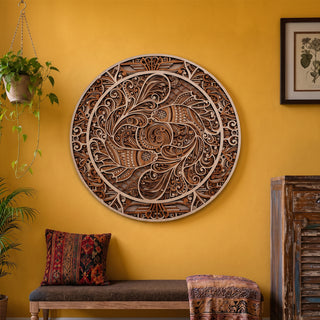
Our 3D Multi-Layered Koi Fish Mandala shows two koi in a continuous circular movement surrounded by sacred geometry. It is made from premium engineered pine (MDF) and currently comes in 24×24 and 34×34-inch sizes. Check the product page for current pricing and availability.
Is koi fish art part of Vastu Shastra?
Koi are not a central motif of classical Indian Vastu Shastra. Many contemporary guides combine vastu directions with feng shui water and fish symbolism, often without explaining the crossover. That does not prevent an Indian home from using koi art; it simply calls for honest language.
A vastu-informed approach can consider direction, element, room activity, and the household’s intention. A cultural-symbolic approach can consider perseverance, partnership, and visual flow. Keep those lenses distinct. If a strict traditional interpretation matters to your family, consult a qualified practitioner familiar with your floor plan rather than relying on a universal internet rule.
Which direction is best for koi fish wall art?
East and north are practical starting points. East can support the idea of renewal and forward movement, while north is frequently linked with career and flow in popular vastu practice. A south-east placement can work visually in a dining or active social zone, but it is not a universal prescription.
| Direction or zone | Common symbolic reading | Good room match | Placement note |
|---|---|---|---|
| East | Renewal, family life, forward movement | Living room, entrance-side wall, study | Use soft side light to reveal the layered relief |
| North | Flow, work, opportunity in popular vastu practice | Home office, study, formal living space | Keep the fish visually moving into the room, if the composition has a clear direction |
| North-east | Quiet reflection | Meditation corner or calm transition | Use only if the non-Indian symbol fits your household’s spiritual context |
| South-east | Active, social, dynamic energy in modern interpretations | Dining or entertaining area | Balance the water motif with the room rather than claiming a fixed vastu result |
| Entry passage | Welcome, movement, a journey into the home | Foyer or wide corridor | Avoid door swings, direct rain, and cramped corners |
Direction should never override physical suitability. A dry, stable east wall is useful; a damp east wall is not. Our Vastu wall art by direction guide gives broader room and symbol combinations for households that use this framework.
Should koi fish face into or out of the room?
Many contemporary placement guides recommend that fish appear to swim into the room rather than out through a door, using the image as a metaphor for welcoming opportunity. This is a symbolic design choice, not a measurable rule. It only applies when the artwork has a clear left-to-right direction.
In a circular two-koi composition, movement is continuous. There may be no meaningful “in” or “out,” and forcing that reading can distort the design. Instead, mount the mandala upright and level, then place it where the circle feels centred from the main view.
How many koi fish are considered auspicious?
Different decorative traditions assign meanings to pairs, groups of eight, or groups of nine. A pair commonly evokes partnership and balance, while larger groups may be connected with abundance in popular feng shui imagery. These associations are not universal Vastu rules.
Choose the number that fits the artwork and the story you want to live with. Our two-koi composition emphasises reciprocity and circular movement. It does not promise a specific outcome, and you do not need to add more fish objects around the room to “complete” it.
Which room is best for koi fish wall art?
A living room is the easiest match because koi art combines narrative and decorative presence. Place it on a wall visible from the entrance or main seating area, with enough blank space around the circle. The living room wall art guide helps balance statement size with sofas, consoles, and lighting.
A home office or study suits the perseverance theme. Hang it where it can be seen from the desk without filling the video-call background edge to edge. A foyer can work when it is broad, dry, and protected from the main door. A meditation area may suit the mandala geometry if koi symbolism belongs naturally in your practice.
Bedrooms are more personal. If the pair reads as calm companionship and the colours suit the room, it can work on a side wall. If the design feels visually active, reserve it for a shared living space.
How do koi and mandala meanings work together?
A mandala organises the image around a centre. Koi add directional movement. Together, the two ideas create a useful tension: motion held within balance. The eye follows the fish and returns to the circle, which is why the composition can feel lively without becoming chaotic.
Mandala is itself a broad term with sacred, ritual, meditative, and decorative uses across Asian traditions. Our guide to mandala layers and symbols explains the centre, radial repetition, lotus forms, and boundaries that often shape these designs.
How should you style a koi fish wall hanging?
Give a circular koi piece one clear job: the focal point. Avoid surrounding it with several unrelated small frames that break the visual movement. A long low console, simple bench, or uncluttered sofa can anchor it without competing.
Use side lighting rather than a harsh spotlight. Layered art changes as shadows move, so a nearby window or warm wall washer can reveal depth. Keep reflective blue accessories limited; the artwork does not need an entire “water theme” around it.
For a 24-inch square piece, test compact living-room, study, or foyer walls. The 34-inch option needs more breathing room. Mark the outline with paper tape and view it from the doorway before ordering. Browse the Passions & Places collection if you want to compare the koi with travel, music, and nature-led forms.
How is layered koi wall art made and cared for?
The artwork is built from multiple laser-cut profiles that are aligned and hand-assembled in our Kanpur workshop. We use premium engineered pine (MDF) for controlled detail and a consistent finished surface. Across our studio work, designs can use up to 9 layers; exact construction varies by piece.
Dust with a soft, dry cloth or clean brush. Do not use water, spray cleaners, or abrasive pads, and do not mount the artwork on a wall showing seepage. When moving it, support the outer structure rather than lifting it by a delicate internal cut-out.
Can koi wall art bring wealth or good luck?
Koi are widely used as symbols of abundance, perseverance, and good fortune, but artwork cannot guarantee wealth or luck. Its meaningful effect is more grounded: it can remind a household of persistence, shared goals, and the ability to keep moving through difficulty.
Use the symbol as an intention, then pair it with practical action. That is a healthier and more respectful way to live with cultural imagery than treating decor as a transaction with fate. For traditional Indian sacred placement, our Vastu wall art guide covers motifs more directly rooted in that context.
Written by Sutrayan Studio. We create made-to-order layered wall art in our workshop in Kanpur.
What do people ask about koi fish wall art?
Which direction should koi fish face?
If the fish have a clear direction, many modern guides prefer movement into the room rather than out through a door. For a circular pair, simply keep the design upright and centred.
Can koi fish art go in the living room?
Yes. A living-room focal wall is one of the most natural placements, especially when the art has clear space around it and is visible from the main seating area.
Is koi fish painting good for Vastu?
Koi symbolism is mainly East Asian rather than a classical Vastu motif. It can still fit a vastu-informed home when the direction, room use, and meaning are chosen thoughtfully.
Can koi art be placed in a bedroom?
It can, particularly when a paired composition feels calm and meaningful to the occupants. If the design or colours feel too active, use a living room or study instead.
Which sources support this guide?
These references support the historical, material, conservation, or regulatory context used above. Spiritual and placement guidance is identified as tradition or interpretation, and decorative objects are not presented as medical, financial, or guaranteed remedies.
- Leaping Carp in Dream Worlds, Smithsonian National Museum of Asian Art
- Fish in Japanese art, Smithsonian National Museum of Asian Art
- IGNCA publications on Vaastu and Indian architectural texts
Editorial review completed 30 August 2026. Product prices and availability can change; check the linked product page before ordering.