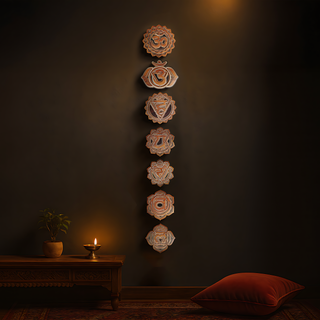
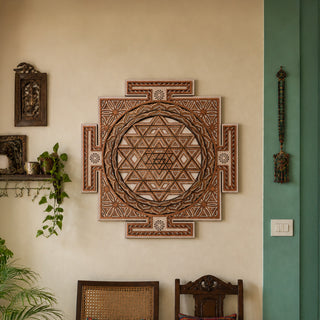
A 7 chakra wall hanging is best used as a visual guide for meditation, yoga, or reflective daily routines, not as a medical treatment. Place it where the full vertical sequence is easy to see, often a meditation corner, pooja room, yoga space, or calm study wall, with enough clear space around the design.

At Sutrayan Studio, we approach the seven chakras as a symbolic system with many interpretations across Indian traditions. Our workshop in Kanpur turns the sequence into layered wall art, while this guide explains the common colours, meanings, benefits, and placement choices without making supernatural or health guarantees.
What are the seven chakras?
Chakra means “wheel” in Sanskrit. In yoga and tantric traditions, chakras are subtle centres used to describe relationships among body, breath, awareness, and spiritual practice. The widely recognised seven-centre sequence runs from Mūlādhāra near the base of the spine to Sahasrāra at the crown.
The rainbow colour system familiar in modern posters and wall decor is a popular contemporary convention, not a single unchanged colour code shared by every historical school. That does not make it meaningless; it means the artwork should be read as a clear modern visual map rather than a substitute for studying a specific lineage.
Our 7 Chakras Spiritual Wall Art is a centred decorative interpretation for meditation rooms, pooja corners, yoga areas, and studies. It is made from premium engineered pine (MDF); check the product page for current pricing and availability.
What do the seven chakra colours and meanings represent?
The common seven-colour sequence moves from red through violet, pairing each chakra with a broad theme. Use these meanings as prompts for reflection: stability, creativity, purposeful action, compassion, expression, insight, and connection. They are not diagnostic categories and should not be used to explain illness or replace professional care.
| Chakra | Common colour | Reflective theme | Useful room context |
|---|---|---|---|
| Mūlādhāra (root) | Red | Stability, belonging, grounded attention | Entry-side meditation corner or a quiet place used for settling |
| Svādhiṣṭhāna (sacral) | Orange | Creativity, feeling, adaptability | Creative studio, yoga room, or journalling corner |
| Maṇipūra (solar plexus) | Yellow | Purpose, confidence, disciplined action | Study or practice space where goals are reviewed |
| Anāhata (heart) | Green | Compassion, relationship, openness | Calm shared room or reflective living-room corner |
| Viśuddha (throat) | Blue | Expression, listening, honest communication | Study, music room, or creative workspace |
| Ājñā (brow) | Indigo | Discernment, inward attention, insight | Meditation wall directly in the relaxed line of sight |
| Sahasrāra (crown) | Violet or white | Connection, contemplation, transcendence | Pooja room or dedicated spiritual-practice area |
What are the benefits of 7 chakra wall art?
The clearest benefit is environmental: a seven-chakra composition can mark a place for practice and give the eye an ordered vertical path. It may help you remember to pause, breathe, journal, stretch, or meditate because the cue remains visible between sessions.
- A defined practice zone: wall art can turn an unused corner into a recognisable place for yoga or meditation.
- A sequence for reflection: the seven themes provide prompts for checking in with priorities and behaviour.
- Visual order: a centred vertical design can calm a wall that otherwise feels fragmented.
- Cultural conversation: the artwork can invite deeper learning about yoga philosophy when approached with curiosity and respect.
- Meaningful decor: it combines symbolism with colour in a form suited to contemporary Indian homes.
Claims that chakra art cures disease, guarantees energy changes, or produces specific life outcomes go beyond what a wall object can establish. The artwork supports an intention; the practice is still yours.
Where should 7 chakra wall art be placed?
Place it in the room where you will actually use its meaning. A meditation or yoga corner is the most direct choice because the chakra sequence relates to the practice happening there. A pooja room can also work when your household includes chakra imagery in its spiritual vocabulary. The pooja room wall decor guide can help you balance it with shelves, lamps, and other sacred objects.
In a study, position it on a side wall visible during a pause, rather than directly behind a bright monitor. In a living room, choose a quiet reading or reflection corner instead of forcing it into the main television composition. Wellness studios can place it where participants see it on arrival or while seated, provided the image is presented respectfully rather than as a promise of treatment.
Keep the wall dry and the area visually simple. A colourful seven-symbol wall hanging already carries substantial information, so it usually needs fewer neighbouring frames than a neutral abstract piece.
Which direction is best for a 7 chakra wall hanging?
North-east and east are common recommendations for spiritual or meditation-oriented art in vastu-informed homes. North-east is often treated as a contemplative zone, while east connects with morning light and the beginning of a daily routine. North can be a practical alternative for a study or quiet work area.
There is no single placement rule shared by every chakra tradition. If a direction creates glare, clutter, damp exposure, or an awkward practice layout, choose the better physical wall. Our room-by-room Vastu wall art guide treats direction as one factor alongside symbolism, respect, and how the room is used.
Avoid turning direction into fear. The purpose of a practice corner is steadiness. If your family follows a specific vastu adviser or spiritual teacher, use their convention consistently rather than combining fragments of several systems.
At what height should chakra wall art be hung?
Hang the centre near the natural gaze of the main viewing position. If you meditate on a floor cushion, sit down before marking the wall; a standard standing eye-level formula will often place the artwork too high. If the piece is used in a study or living room, a centre height around 145 to 155 cm from the floor is a useful starting point, not a rigid rule.
Keep the full sequence upright, with the root at the bottom and crown at the top. Do not crop the design behind furniture or hang it so low that a chair back cuts through the lower symbols. Use a paper outline to test the location in morning and evening light before drilling.
How do you style chakra wall art without making the room busy?
Begin with restraint. Let the seven-colour sequence be the accent, then repeat only one or two of its quieter colours in a cushion, yoga mat, runner, or small object. Neutral walls, natural textures, and warm indirect light help the symbols remain legible.
In a compact Indian apartment, the artwork can define a meditation corner with a floor cushion, a small closed storage unit, and one warm light. In a larger yoga room, give it clear wall width and align the centre with the practice area. Avoid placing a tall plant or lamp directly in front of the lower chakras.
If you want a wider selection of symbol-led pieces, explore our Sacred Wall Icons collection. For a less literal radial composition, the mandala tradition offers another route to centred visual rhythm.
How is layered chakra wall art made and cared for?
Layered wall art begins with a digital design broken into cut profiles. The forms are laser-cut from premium engineered pine (MDF), aligned, assembled, and finished by hand in our Kanpur workshop. Across the studio collection, designs may use up to 9 layers; the exact construction depends on the piece.
Use a soft, dry microfibre cloth or clean brush to remove dust. Do not wet the surface or spray cleaner into the recesses. Keep it away from damp walls, bathroom steam, and direct splashes. For seasonal maintenance, follow our Indian humidity care guide for layered wood art.
How can you use chakra art in a daily practice?
Choose a small repeatable action. You might sit for five quiet minutes, move attention from the lower symbol upwards, or choose one theme for journalling. The wall art provides the sequence; it does not prescribe a religious practice.
Keep the routine simple enough to continue on ordinary days. If you study within a yoga lineage, let its teacher and texts guide the meaning of each centre. For a broader discussion of direction and sacred imagery, our Vastu-compliant wall art article adds useful context.
Written by Sutrayan Studio. We create made-to-order layered wooden wall art in our Kanpur workshop.
What do people ask about 7 chakra wall art?
Which wall is best for 7 chakra art?
An east or north-east wall in a meditation, yoga, pooja, or quiet study area is a common choice. A dry, uncluttered, usable wall matters more than forcing an impractical direction.
Can I place seven chakra art in the bedroom?
You can if the bedroom includes a calm meditation corner and the imagery helps you settle. If the colours feel stimulating near the bed, move it to a study or practice space instead.
Does chakra wall art bring positive energy?
Many people use it as a symbol of balance and intentional practice. Any felt change comes from the meaning, habits, and environment you build around it; the artwork does not guarantee an energetic result.
Is a 7 chakra wall hanging religious?
Chakras come from Indian spiritual and yogic traditions, although the imagery is now used in many wellness settings. Treat the symbols respectfully and learn the context rather than reducing them to decoration alone.
Which sources support this guide?
These references support the historical, material, conservation, or regulatory context used above. Spiritual and placement guidance is identified as tradition or interpretation, and decorative objects are not presented as medical, financial, or guaranteed remedies.
- Cakra, The Concise Oxford Dictionary of World Religions
- Study on the formation of the Western chakra system, Korea Citation Index
- Basic care for wooden objects, Canadian Conservation Institute
Editorial review completed 30 August 2026. Product prices and availability can change; check the linked product page before ordering.