
The Definitive Guide to Vastu-Compliant Wall Art (2026)
Where to hang mandalas, yantras, and 3D wooden wall art so they work with the energy of an Indian home.
 The Sutrayan Team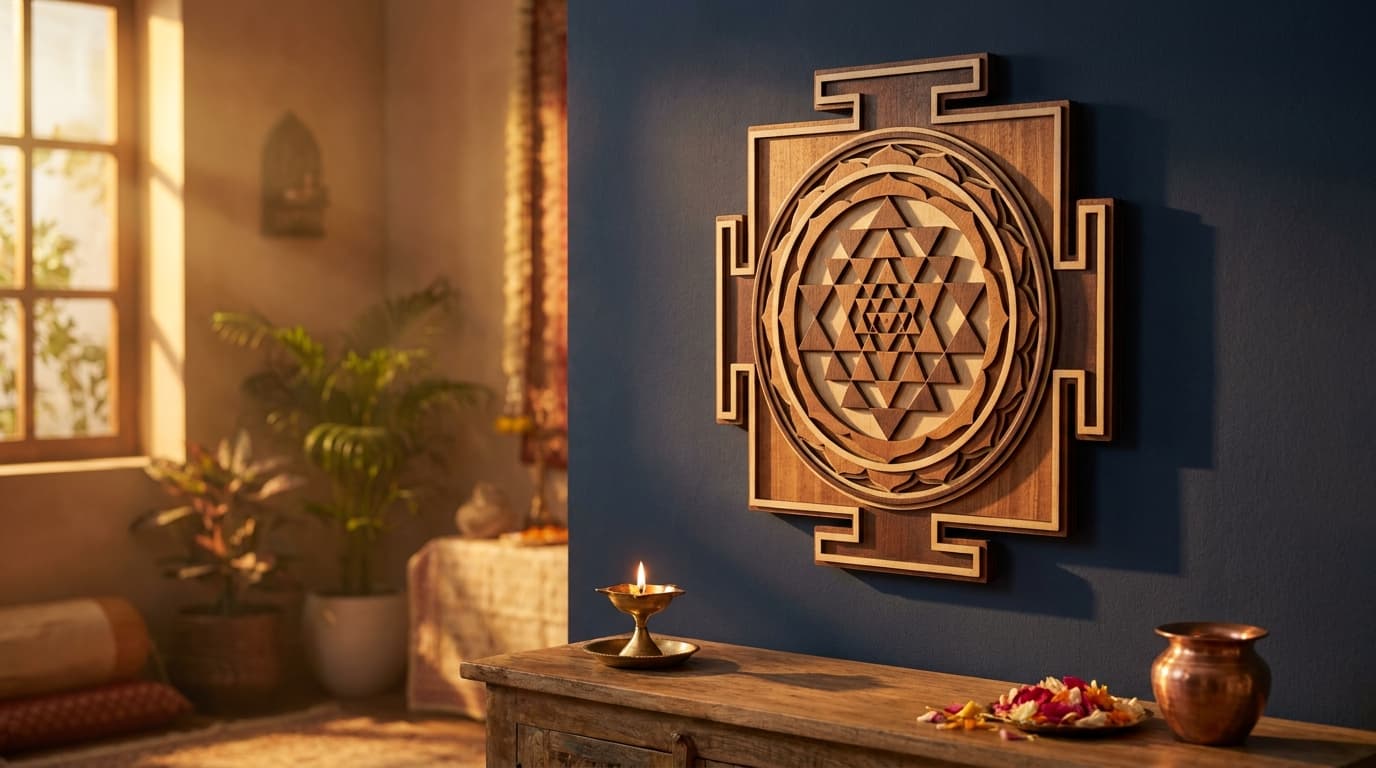
What counts as "Vastu-compliant" wall art
Vastu Shastra, the classical Indian treatise on architecture and placement, treats the direction and material of wall art as part of a room's energetic balance. Not every decorative piece qualifies as Vastu-compliant. The tradition focuses on three criteria — sacred geometry, material integrity, and directional placement.
Sacred geometry means pieces rooted in yantric or tantric iconography: the Shree Yantra, the 7 Chakras system, Om, Ganesh, mandalas derived from lotus or radial symmetry. Decorative art without that geometric root (abstract paintings, landscape canvases) is neutral — it neither helps nor hurts Vastu, but it is not considered Vastu-compliant.
Material integrity favours natural materials — wood, copper, clay — over synthetic. Handcrafted wooden wall art sits at the top of Vastu-preferred materials because wood is considered a "living" substance and layered wood carries depth and warmth.
Directional placement is the rule most people get wrong. A beautiful Shree Yantra on a south-facing bedroom wall is, by strict Vastu, neutralised. The direction matters.
Direction-by-direction placement guide
- East (rising sun): prosperity and wealth pieces — Shree Yantra, Kuber Yantra, Lakshmi iconography. The best wall in a pooja room for the Shree Yantra Sacred Wall Art.
- North-east: meditation and spiritual growth — 7 Chakras, Om, Ganesh. A strong placement for the 7 Chakras Spiritual Wall Art.
- North: career and opportunities — mandalas, world maps, landscape art. The 3D Wooden World Map works well in a study or office on the north wall.
- West: creativity, children's rooms — floral art, natural motifs. The Bloom Whirl Flower Art fits here.
- Avoid: bathroom-adjacent walls, under stair-cases, and behind the head of a bed (for sacred-geometry pieces).
Placing wall art in the pooja room
The pooja room is the most intentional Vastu space in an Indian home. Traditionally the altar faces east so worshippers face east during prayer. The wall art follows: the most auspicious piece goes on the east-facing wall at eye level or slightly above.
For the Shree Yantra specifically, the east-facing placement is tightly prescribed in tantric practice. The yantra is a geometric representation of divine feminine energy (Tripura Sundari) and the east is where the sun rises — the directional pairing is not decorative, it is intentional.
For meditation-focused practice, the 7 Chakras piece works on the north-east wall or directly behind a meditation cushion. The chakra map flows from Mūlādhāra (base) at the bottom to Sahasrāra (crown) at the top — the piece should be mounted so Mūlādhāra is closer to the floor.
Placing wall art in the living room
The living room is less prescriptive than the pooja room, but the Vastu rules still point to a few strong placements. The south wall is considered the "strong" wall of the living room (grounding energy); a large mandala or world map on the south wall becomes the room's focal centre without conflicting with the east's sacred-geometry placements.
For couples setting up a new home, the Griha Pravesh tradition favours a single prominent wall art piece in the living room — something every guest notices, something the family comes home to. A Bloom Whirl mandala or a 3D Wooden World Map both work in this role.
Placing wall art in the bedroom
Bedroom Vastu is simpler: avoid sacred-geometry pieces behind the head of the bed (too energetically active for sleep) and avoid water-theme or koi-fish art directly above the bed. Soft, natural motifs — a minimalist feather sculpture, a floral mandala on the wall opposite the bed — work well.
Material choices matter
A Vastu practitioner will tell you that a printed canvas of a Shree Yantra carries less weight than a hand-crafted wooden one. The reason is material integrity — wood is a natural substance, layered and hand-finished art carries the intention of its maker, and printed reproductions do not.
Every Sutrayan piece is made to order at our workshop in Kanpur, laser-cut from FSC-certified engineered pine, assembled in 5–12 stacked layers, and hand-finished with water-based non-toxic stains. For Vastu buyers specifically, this material integrity is part of the case.
Frequently asked questions
Can I hang a Shree Yantra on a wall that isn't east-facing?
The east-facing wall is traditional and strongly preferred, especially in pooja rooms. If layout doesn't allow east, north-east is the second-best direction. Avoid south and west for the Shree Yantra.
Does the mandala have to be a specific design for Vastu?
Strictly speaking, the sacred-geometry mandalas (Shree Yantra, Sri Chakra) are the ones with explicit Vastu placement rules. Floral and decorative mandalas are more flexible — they carry the mandala's meditative quality without the directional strictness.
Should I avoid any wall art in the bedroom?
Avoid sacred-geometry pieces behind the head of the bed. Avoid aggressive water imagery (storms, roaring water) anywhere in the bedroom. Soft floral, minimalist, or quiet natural motifs are Vastu-friendly for sleep spaces.
Is a 3D wooden map Vastu-appropriate for a home?
Yes, on the north wall (career and opportunities) or in a study/office. The 3D Wooden World Map is a popular choice for study rooms and offices because of this directional alignment.
Last updated: April 2026. For personalised Vastu guidance, consult a qualified practitioner — this guide covers common cases only.