
The Anatomy of a Mandala: What the Layers Represent
The geometry, tradition, and symbolism behind a handcrafted multi-layered mandala — from ancient meditation aid to modern home wall art.
 The Sutrayan Team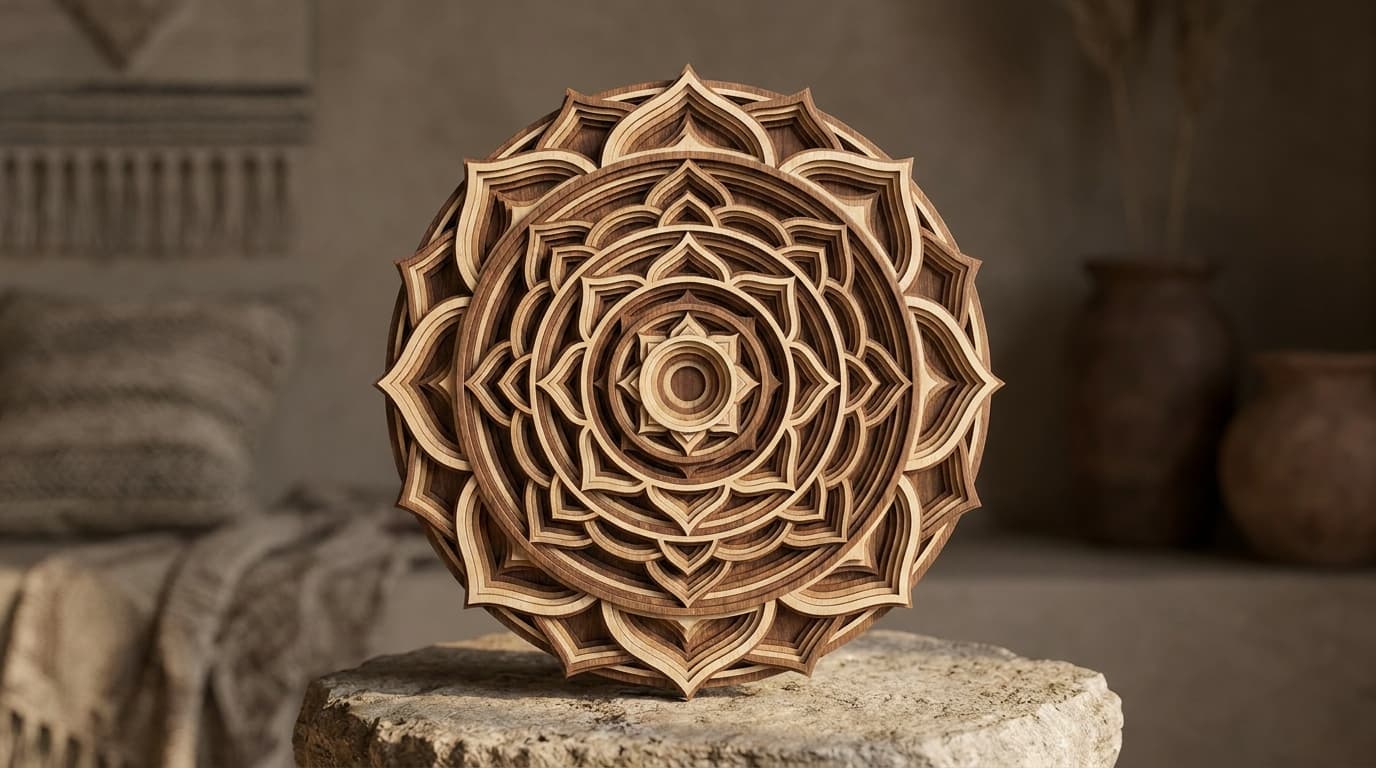
Origin — a meditation map, not just decor
The mandala form originates in both Hindu and Buddhist tantric traditions, where it served as a structured aid for meditation. A practitioner would visualise the outer ring and move concentrically inward — the gaze following a geometric path from the world's complexity toward the central point of unity. The mandala wasn't decoration; it was architecture for the mind.
Modern wall art mandalas inherit this structure. A well-designed multi-layered wooden mandala — like the Bloom Whirl Flower Art in the Sutrayan catalogue — preserves the concentric form even when the motifs are floral rather than traditional-tantric.
The layers, outer to inner
The outer ring — the wall of fire or flames
In classical mandala iconography, the outermost ring is the "wall of fire" — a protective boundary that separates the sacred geometric space from the ordinary world. Modern decorative mandalas render this as an ornamental border, but the protective intention is preserved.
The cardinal gates
Inside the outer ring, four gates mark the compass directions — east, south, west, north. These are the entry points into the mandala. In traditional practice, the meditator imagines entering through the east gate and moving inward.
The lotus ring
A ring of lotus petals typically forms the middle layer. The lotus represents purity — a flower that blooms from muddy water — and marks the threshold between the outer protective layers and the inner sanctum.
The inner circle
The inner circle is where the deity or principal symbol resides. In a Shree Yantra this is where the interlocked triangles culminate; in a chakra mandala this is where the central colour or seed-syllable sits.
The bindu — the central point
At the very centre is the bindu — a single point, the geometric representation of absolute unity. In meditation, the bindu is where the concentric journey ends. Everything else radiates from it.
Sacred mandala vs. decorative mandala
Not every mandala carries explicit spiritual geometry. Indian and global decorative mandalas (floral mandalas, mehndi mandalas, minimalist radial art) borrow the concentric form without strictly following tantric geometry. Both are valid expressions.
Sutrayan's catalogue includes both registers:
- Sacred geometry mandalas — Shree Yantra, 7 Chakras. These follow explicit tantric or yogic geometry.
- Decorative mandalas — Bloom Whirl Flower Art, Koi Fish Mandala. These carry the concentric meditative form with modern or regional motifs.
Why multi-layered wood matters for mandalas
A printed mandala is flat — the geometric intent is there, but the depth that the form traditionally implied (the movement inward through space) is lost. A multi-layered wooden mandala physically embodies the layered journey — each ring sits at a different height, casting shadows as light falls across it.
Sutrayan mandalas stack 5 to 9 layers of 3–6 mm engineered pine. Morning light throws the outer ring's shadow onto the inner; the bindu sits proud at the centre. The geometric intention of the traditional mandala and the physical depth of handcraft align.
Placement in a home
Decorative mandalas work on living-room focal walls, entryways, and bedrooms. Sacred-geometry mandalas (Shree Yantra, 7 Chakras) have traditional directional placement — see our Vastu wall art guide for the specifics. For pooja-room placement, our pooja-room collection covers the right-fit pieces.
Frequently asked questions
What does a mandala represent in Hindu and Buddhist traditions?
A mandala represents the cosmos as a geometric map — the concentric form illustrates the journey from the outer world toward a central unified point.
Is a mandala religious or decorative?
Both. Sacred-geometry mandalas (Shree Yantra, Sri Chakra) are explicitly spiritual. Floral and regional mandalas inherit the concentric form as a meditative design without the tantric specificity.
Where should I hang a mandala at home?
Living-room focal walls, pooja rooms (for sacred-geometry mandalas), meditation corners. Avoid bathrooms and high-humidity kitchens.
Last updated: April 2026. Explore the Sutrayan mandala collection.